



Titanium Dioxide Uses Across Food and Industry
By on Jul 30th 2026
From Ranch Dressing to Self-Cleaning Glass: Titanium Dioxide Uses Across Industries
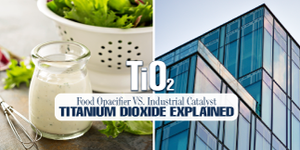
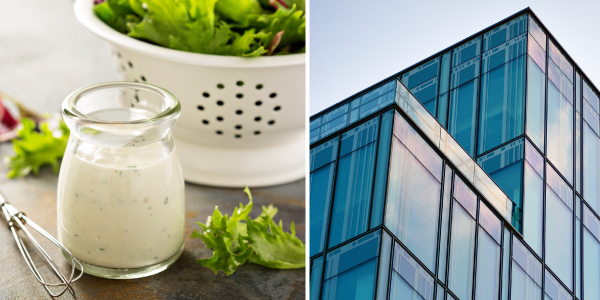
A food manufacturer can use titanium dioxide to give a creamy dressing a brighter, more opaque appearance. A building-material manufacturer can use the same chemical compound in a coating that helps break down grime and airborne pollutants on glass or concrete.
That sounds like two unrelated ingredients. It is not.
Both applications use titanium dioxide, commonly written as TiO2. What changes is the material’s crystal structure, particle design, surface treatment, and grade. Those differences determine whether titanium dioxide behaves primarily as a stable white pigment or as a light-activated catalyst.
Understanding that distinction is useful for anyone purchasing titanium dioxide powder. The right product is not simply “titanium dioxide.” It is the grade designed for the intended process, market, and regulatory environment.
What Is Titanium Dioxide?
Titanium dioxide is a white, inorganic compound valued for its ability to interact with light. It occurs in several crystalline forms, with rutile and anatase being the two most commercially important.
The atoms in both forms have the same basic chemical composition. They are arranged differently within the crystal lattice, however, and that changes how the material handles light and chemical reactions.
Rutile has a higher refractive index, which allows it to scatter light efficiently. It is also generally more stable and less photocatalytically active than anatase. These properties make rutile especially useful where manufacturers want durable whiteness, opacity, and UV resistance.
Anatase is generally more reactive under ultraviolet light. When activated, it can generate highly reactive species that help break down certain organic compounds and pollutants. This is the principle behind photocatalytic glass, concrete, coatings, and water-treatment research.
This creates two broad roles for titanium dioxide. Rutile is generally favored when the goal is stable whiteness, opacity, or control of light. Anatase is generally favored when the goal is photocatalytic activity, meaning the material uses light energy to help drive chemical reactions at its surface.
These roles are not absolute. Commercial performance also depends on particle size, surface area, coatings, purity, and formulation. Still, the rutile-versus-anatase distinction provides a useful starting point for understanding why titanium dioxide can function as both a white pigment and a reactive material.
This table describes a general performance pattern, not a strict rule. Both rutile and anatase can appear in pigment applications, including food-related uses.
Some photocatalytic materials also combine anatase and rutile to achieve specific performance characteristics.
Ensure your formulations meet high purity, opacity, and performance standards with verified ingredients.
Browse Titanium Dioxide Products at IngrediThe Whitener: Why Titanium Dioxide Creates Opacity
Titanium dioxide does more than make a product look white. Its high refractive index lets finely dispersed particles scatter incoming light, reducing transparency and increasing opacity.
That is useful in products where manufacturers need a clean, uniform appearance or need to cover the natural color of other ingredients.
Food and Beverage Applications
Food-grade titanium dioxide has historically been used to brighten and opacify products such as:

- Creamy dressings and sauces
- Non-dairy creamers
- Frostings and icings
- Confectionery shells and coatings
- Bakery decorations
- Powdered mixes
- Certain dairy-style products
Its role is visual. Titanium dioxide does not sweeten, preserve, thicken, or flavor the food. It changes how light passes through the finished product.
Food use is regulated differently by country. A manufacturer must confirm that titanium dioxide is authorized in the target market and that the specific product meets the required identity, purity, labeling, and usage restrictions.
Toothpaste, Pharmaceuticals, and Personal Care
Titanium dioxide can provide whiteness and opacity in toothpaste, creams, lotions, soaps, makeup, and other personal-care products.
Pharmaceutical manufacturers may also use appropriate grades in tablet and capsule coatings. The white coating creates a consistent appearance and can help conceal the natural color of the active ingredients beneath it.
Sunscreen is a more specialized application. Titanium dioxide can scatter and absorb ultraviolet radiation, which is why properly designed cosmetic and sunscreen grades are used as mineral UV filters. These grades may be coated or surface-treated to improve dispersion and limit unwanted photocatalytic activity.
Paint, Paper, Plastics, and Road Markings
The largest industrial use of titanium dioxide is as a white pigment. In paint and coatings, it contributes:
- Opacity
- Brightness
- Hiding power
- Color consistency
- Resistance to discoloration
- Protection from some effects of UV exposure
Paper manufacturers use it to increase brightness and opacity, particularly in coated or specialty papers. Plastics manufacturers use titanium dioxide to create white components, improve opacity, and help protect polymers from light exposure.
Road-marking paints also benefit from strong whiteness and visibility. In these applications, a pigment must remain stable rather than react with the resin, plastic, or surrounding material. This is one reason rutile-based pigment grades are widely favored.
The Reactor: When Titanium Dioxide Uses Light to Do Work
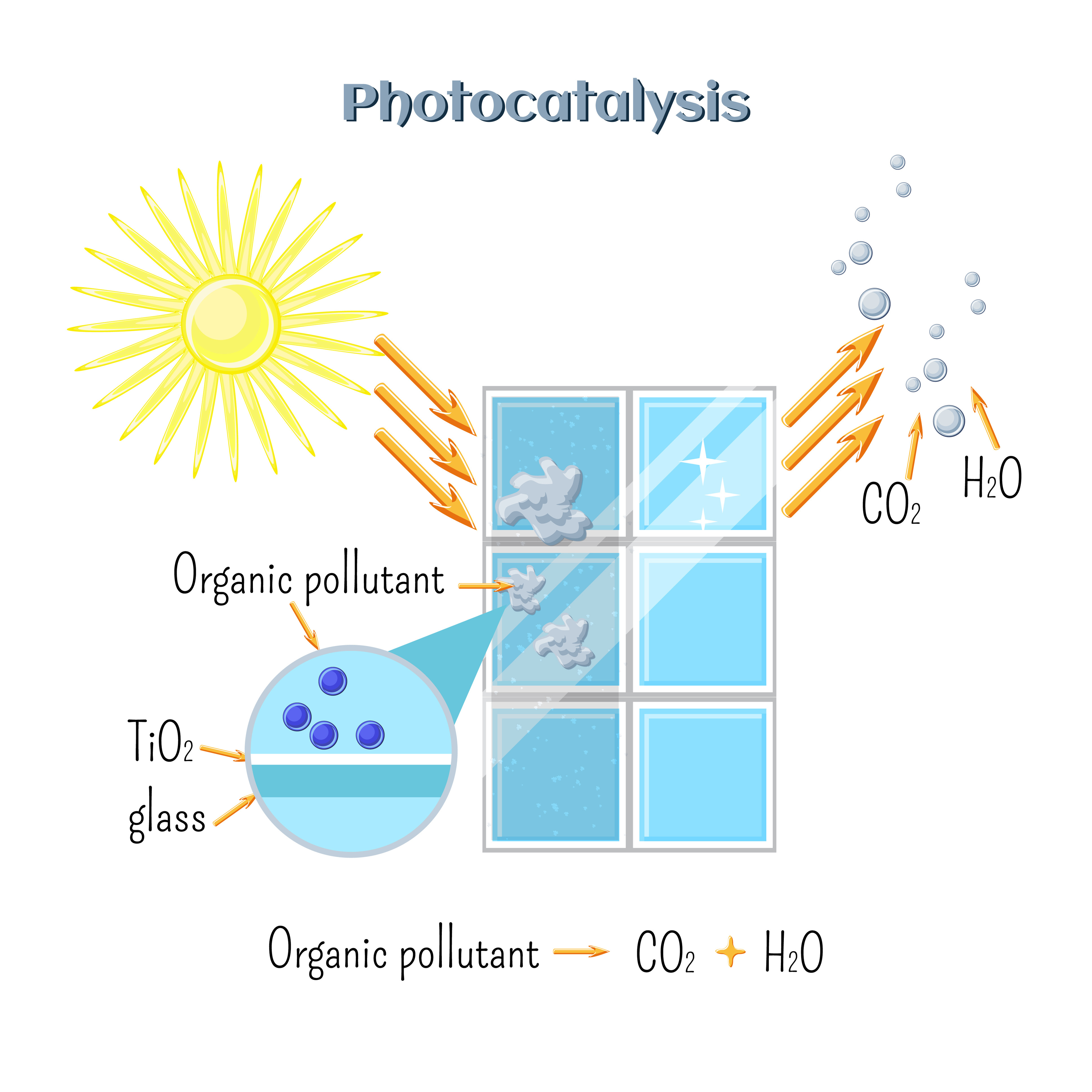
Anatase titanium dioxide behaves differently when exposed to sufficient ultraviolet energy.
Light can excite electrons within the material and create electron-hole pairs. These can react with oxygen and water at the surface, forming reactive species capable of oxidizing certain organic contaminants.
In plain terms, the titanium dioxide helps use light to drive a chemical cleanup process.
Self-Cleaning Glass
A thin titanium dioxide coating can help a glass surface manage organic grime in two ways.
First, photocatalytic activity breaks down some organic residue on the surface. Second, the treated surface can become highly water-attracting, allowing rainwater to spread into a thin sheet instead of forming separate droplets. The water can then carry loosened material away more evenly.
The glass does not become maintenance-free, and performance depends on sunlight, coating design, weather, and the type of contamination. Still, the technology can reduce how strongly certain organic materials adhere to the surface.
Air-Purifying Concrete and Coatings
Photocatalytic titanium dioxide can be incorporated into or applied to concrete, pavement, exterior coatings, and other building materials.
Under suitable light conditions, the material can help oxidize pollutants such as nitrogen oxides and some volatile organic compounds at the surface. Laboratory and field performance can vary based on humidity, light intensity, pollutant concentration, surface wear, and the way the titanium dioxide is incorporated.
The phrase “smog-eating concrete” makes a good headline, but it oversimplifies the process. Titanium dioxide does not vacuum pollution from an entire city. It facilitates surface reactions under the right conditions.
Water Treatment and Antimicrobial Surfaces
Photocatalytic titanium dioxide is also studied and used in specialized water-treatment systems to break down certain organic contaminants.
Similar chemistry can reduce microorganisms on treated surfaces under appropriate activation conditions. Results depend on the microorganism, light source, contact time, titanium dioxide formulation, and surface design. A generic titanium dioxide powder should not be assumed to provide antimicrobial performance.
Solar and Photoelectrochemical Technology
Anatase titanium dioxide is widely studied in dye-sensitized solar cells and related photoelectrochemical systems.
In these devices, titanium dioxide can provide a high-surface-area structure that accepts and transports electrons generated after a dye absorbs light. The titanium dioxide is not acting as a white pigment. Its electronic and surface properties are the reason it is there.
Same Formula - Different Material Behavior
The surprising part is not simply that titanium dioxide appears in many industries. Plenty of ingredients do.
What makes titanium dioxide unusual is that the same chemical formula can support two very different jobs:
Scatter light while remaining stable
Absorb light energy and help drive surface reactions
Crystal structure helps determine which behavior dominates. Rutile is generally better suited to durable pigment applications because of its optical efficiency and lower reactivity. Anatase is generally preferred when photocatalytic activity is the objective.
Commercial selection is more complicated than choosing one word from a specification sheet. Manufacturers may alter particle size, crystal composition, surface area, coatings, morphology, and surface chemistry to produce a grade for a particular application.
How to Choose the Right Titanium Dioxide Grade
Before purchasing titanium dioxide, buyers should answer several practical questions.
- 1. What is the intended application? A food colorant, sunscreen active ingredient, paint pigment, and photocatalytic coating are not interchangeable products. Start with the technical function required in the finished formulation.
- 2. What grade is required? Confirm whether the application needs a food, pharmaceutical, cosmetic, technical, pigment, or photocatalytic grade. The product documentation should support the intended use.
- 3. Is rutile or anatase more appropriate? Rutile is commonly selected for stable whiteness, opacity, and weather resistance. Anatase is commonly selected for photocatalytic activity. Some applications use anatase as a pigment, while engineered mixtures can outperform either form alone in certain photocatalytic systems.
- 4. What particle and surface properties matter? Particle size, particle-size distribution, surface area, morphology, and surface treatment affect opacity, reactivity, dispersibility, and processing.
A sunscreen grade, for example, may be designed very differently from a conventional paint pigment even when both contain rutile titanium dioxide. - 5. How will the powder be dispersed? Titanium dioxide is insoluble in water. It must be distributed throughout the formulation rather than dissolved.
Poor dispersion can produce clumps, uneven color, settling, reduced hiding power, or inconsistent performance. Buyers should consider the mixing equipment, liquid phase, surfactants, processing sequence, and supplier guidance. - 6. Which regulations apply? Requirements depend on the application and destination market. Review the specification sheet, Safety Data Sheet, certifications, purity information, and regulatory documentation before approving a material.
Ingredi offers NATRACOL Titanium Dioxide in 55-pound bags. It is sold as a food-grade white colorant. Buyers should review the available documentation and confirm that the product is appropriate and permitted for their specific formulation, use level, and sales market.
View NATRACOL Titanium Dioxide Documentation & PricingWhy Is Food-Grade Titanium Dioxide More Controversial?
Food use receives more public attention because ingestion creates a different exposure route than using titanium dioxide inside cured paint, plastic, paper, or exterior glass.
Regulators also evaluate individual uses rather than issuing one universal judgment about the chemical in every form and application.
In the United States, the FDA currently lists titanium dioxide as a permitted color additive for foods generally, subject to specifications and a limit of no more than 1 percent by weight of the food. The FDA is also reviewing new information and a petition requesting that the food authorization be revoked.
The European Union removed authorization for titanium dioxide as a food additive after the European Food Safety Authority concluded that it could not rule out genotoxicity concerns from ingestion. EFSA specifically noted that its assessment concerned titanium dioxide used as a food additive, not its unrelated industrial uses.
For manufacturers, the practical lesson is not to rely on a generic statement that titanium dioxide is either “approved” or “banned.” Its status depends on the jurisdiction, application, product grade, and route of exposure.
Frequently Asked Questions About Titanium Dioxide Uses
Need help sourcing the right titanium dioxide grade for your application?
Contact Ingredi Support