

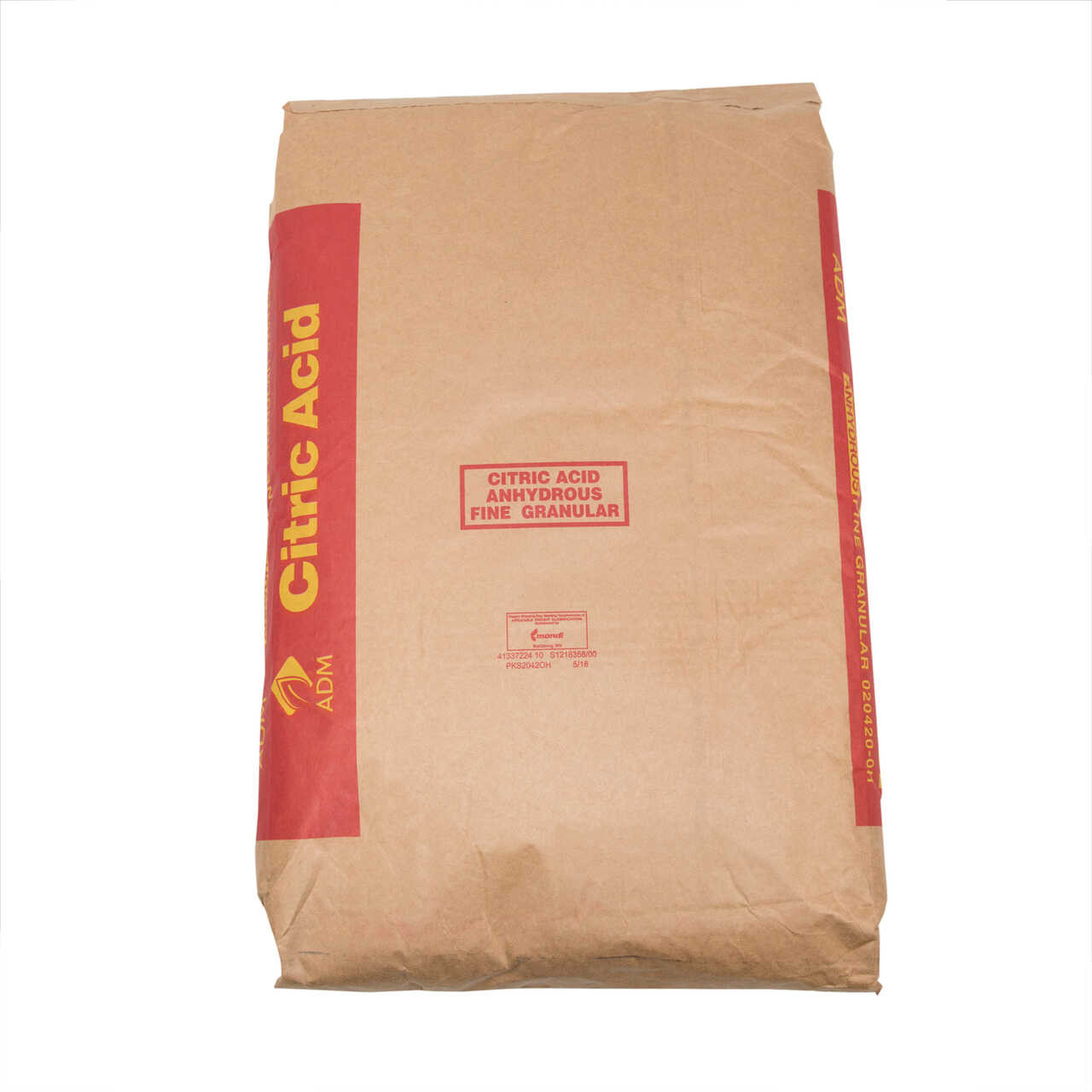
Citric Acid Anhydrous USP/FCC is manufactured and packaged by Archer Daniels Midland (ADM) in bulk 50 pound bags.
Citric Acid is an ingredient used in food, beverage, and other industries. It brings a clean, refreshing tartness to any product it is added to. Citric Acid is primarily an acidulant but can also be used as a sequestrant of metal ions to protect from the development of off-flavors and off-odors in certain foods. Its major use is in the manufacturing of ecologically compatible detergents.
Applications and Uses
- Flavoring Agent: Used to add a tart, acidic flavor to food and beverages, such as soft drinks, fruit juices, and candy.
- Preservative: The acidity of citric acid allows it to be used as a preservative to extend shelf life.
- pH Adjuster: Used to adjust the pH of product as it is a weak acid (can help balance the acidity or alkalinity of a solution).
- Chelating agent: It can bind to metal ions and help stop/prevent oxidation or discoloration.
Specifications
ADM Citric Acid Fine Granular meets USP/FCC standards. It complies with all requirements of the U.S. Pharmacopeia, Code of Federal Regulations, European Pharmacopeia, British Pharmacopeia, Japanese Pharmacopeia, and W.H.O./F.A.O. Food Additive Specifications. Assay (anhydrous basis) 99.5 to 100.5%.
Characteristics
ADM Citric Acid Fine Granular is a free-flowing, odorless, colorless, translucent crystal or white granular to fine crystalline powder. Its pH value is at 1.8 at 25°C and soluble at 590g/1 at 20°C.
Food & Beverage Applications
Citric Acid is found naturally in many citrus fruits, such as oranges, lemons, limes, grapefruits, and tangerines. However, it is also commonly found as an additive in many foods, beverages, and snacks. Examples include:
- Soft drinks, energy drinks, and sports drinks
- Fruit juices and juice drinks
- Candies, gummies, and other confections
- Canned fruits and vegetables
- Jams, jellies, and preserves
- Salad dressings and marinades
- Baked goods such as cakes, pastries, and breads
- Yogurt, ice cream, and other dairy products
- Potato chips, popcorn, and other snacks
- Baby food and infant formulas
Personal Care Applications
In Personal Care & Cosmetics, it is commonly used due to its ability to regulate pH, exfoliate, and its antioxidant properties. Examples include:
- Shampoos & Conditioners: helps remove mineral buildup, increase shine, and balance pH
- Body Washes & Soaps: Natural preservative and pH adjuster
- Face Washes & Scrubs: Gentle exfoliant, improving texture and tone while removing dead skin cells
- Moisturizers & Serums: Boost collagen production, brighten complexion
- Sunscreen: Stabilizer, helping to prevent active ingredients from breaking down and losing efficacy
- Anti-aging: Reduce appearance of fine lines/wrinkles, and improve skin elasticity and firmness